The empire of AI is cracking. And our movement has the path forward to deepen those cracks and bring the light in.
We proved this at a gathering with Karen Hao, NY Times bestselling author of Empire of AI and journalist covering issues related to technology, politics, and society.
We hosted this convening in New York because data centers are touching every aspect of the social sector — from racial justice to tech justice, utility justice to climate justice. The movement has an opportunity to use this flashpoint and organizing around data centers to fundamentally change how communities contest for power against tech oligarchs.
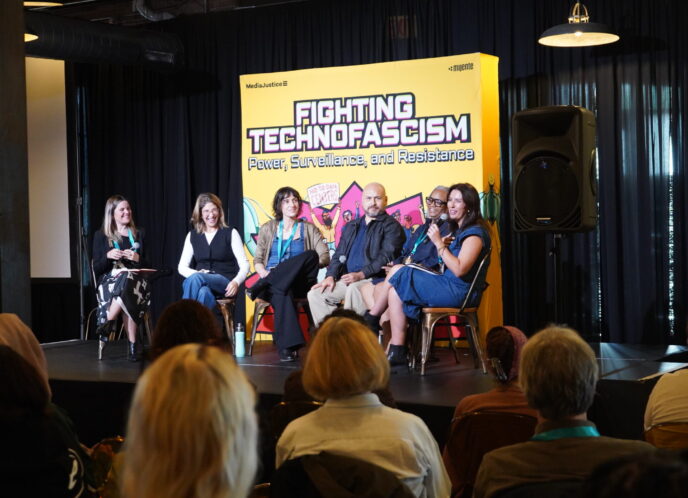
Organizers from South Memphis, Tucson, and the Texas Panhandle took the stage to share what it looks like to fight the AI empire in your own backyard. Together, their campaigns have stopped or stalled $3.7 billion in data center projects.

“There is a massive human cost of the construction of data centers in Texas. We don’t have a lot of generational wealth. Texas is full of people that work hard for a living and perform trades that have been passed down for thousands of years. It’s very intrinsic to our system of values and the way that we behave as a society. So something that has happened a lot in this fight is our local government, state government, and federal government has failed these communities in no longer supporting ranchers and farmers, which is our main source of economy in Texas, especially in the Panhandle.” – Ash Major, Panhandle 1st Coalition
“What motivated so many people to fight back, there’s the intersection of so many fights, but one thing that really struck a chord with a lot of people was there was a project coming in that wanted to use our water, water that is meant to support life and they wanted to use it for profit.” – KA, No Desert Data Center Coalition

“This is not just a movement for clean air. This is not just a movement for clean water. This is a movement for a more democratic way to live where we craft, create, and live in a space that we engineer, not in the imaginations of the wealthiest.” – KeShaun Pearson, Director, Memphis Community Against Pollution

In closing, Karen brought the national context and the window into just how vulnerable the AI industry is:
“The revenue targets are insane. They have to execute flawlessly for this to work out. So what I have started telling people around the world – let’s not make it go flawlessly. And that is exactly what all the data center protests have done. It’s thrown a massive wrench into their plans.”

MediaJustice has a few core hypotheses in this work:
First, every community motivated to fight a data center becomes part of an organizing bloc to defeat the entire industry that created it. That’s why we’re committed to supporting emergent, winnable fights to grow their coalitions while we strengthen the organizing capacity of leaders who are already at the forefront.
Second, you can’t contest for power unless you change the story. And you can’t change the story unless you contest for power. That’s why we uplift local fights to the national stage and why we are so focused on building narrative and organizing capacity.
And finally, saying “no” to data centers creates political opportunity for progressive policy interventions. That’s why you’ll find MediaJustice supporting communities who want to stop and block data center projects without a backup plan like a Community Benefits Agreement.
What’s next?
To Karen’s point, we have proof of concept. The industry is vulnerable and we are growing stronger.